

Lucien Stolze, Massimo Rolle
2026
Laboratory experiments and reactive transport simulations reveal how shifting salinity, complex mineral coatings, and multiphase partitioning determine an aquifer’s ability to retain arsenic.
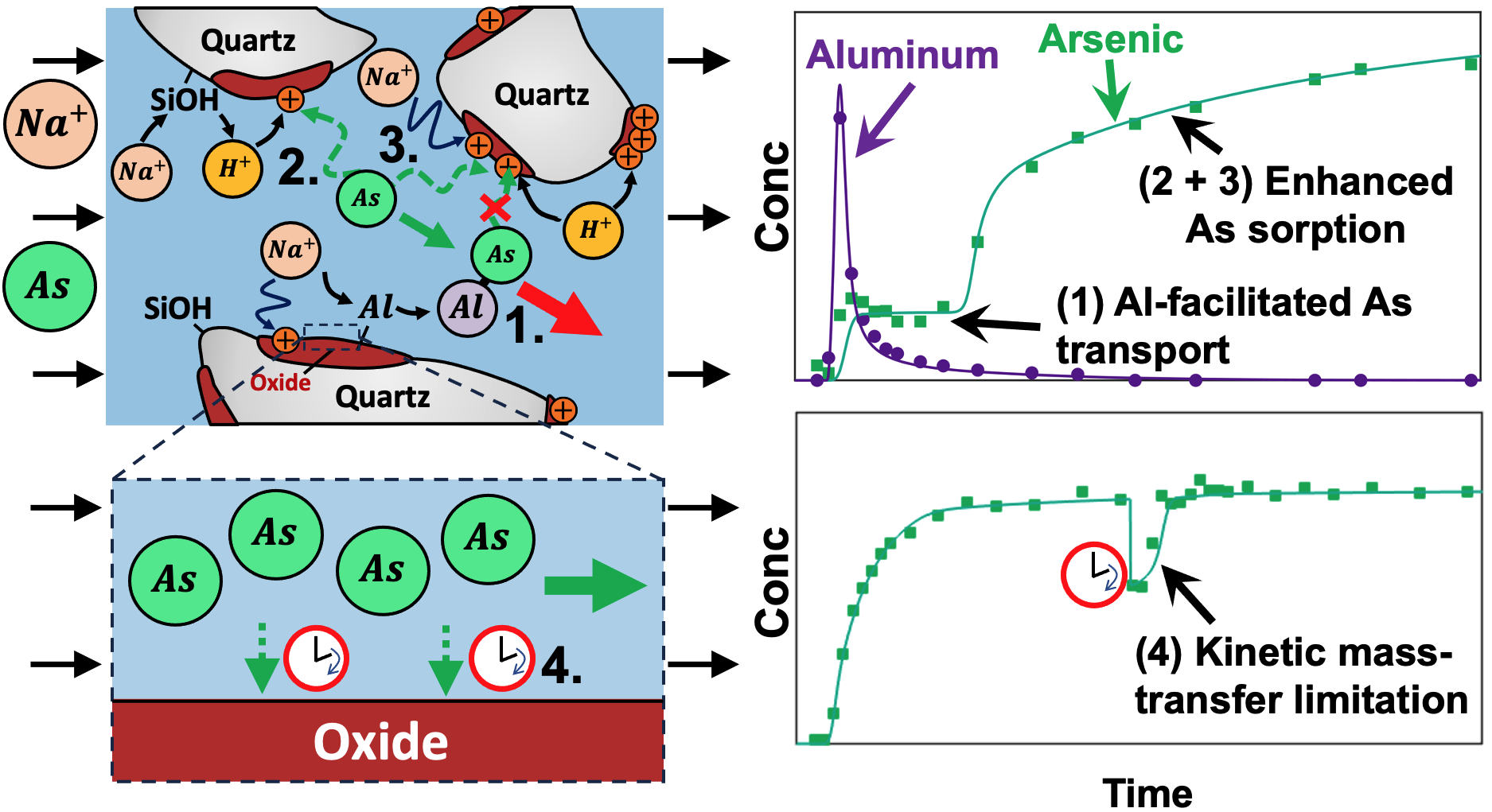
Illustration of coupled mechanisms controlling arsenic mobility. Experimental data and modeling reveal how transient salinity shifts induce a fast-traveling pulse of aluminum-facilitated arsenic (1), while complex interactions between quartz and metal oxides (2, 3), and kinetic mass-transfer limitations (4), govern the retention of the remaining arsenic plume. Image courtesy of Stolze and Rolle (2026), open access (CC BY 4.0).
Background. Arsenic contamination of sandy aquifers is a problem of enormous scale affecting the health of millions of people. In these environments, the mobility and fate of arsenic are primarily controlled by its interactions with metal oxides present at the surface of sand grains. Changing salinity and pH conditions, driven by climate change, sea-level rise, and agricultural practices, can affect these interactions, potentially exacerbating the contamination of freshwater resources. Understanding how transient water chemistry, groundwater flow, and the complex mixture of minerals in natural sands interact to control whether arsenic partitioning between water and solid materials is critical for predicting the evolution of water quality and implementing effective mitigation and remediation strategies.
Key Discoveries. This research reveals that sudden shifts in groundwater salinity can induce multiple, simultaneous transport modes for arsenic. A surge in salinity mobilizes surface-bound aluminum, which binds with arsenic and acts as a fast-traveling carrier. This creates an early, rapid pulse of contamination that bypasses the aquifer’s normal filtration capacity. Simultaneously, the bulk quartz sand reacts with the electrolyte ions to lower the local pH, while the salinity alters the surface charge of metal oxide coatings. This combination of effects helps those coatings trap the remainder of the arsenic plume. Furthermore, the kinetics of mass transfer between the pore water and the solid sediment plays an important role in limiting arsenic adsorption. Flowing groundwater transports the contaminant away before it can fully equilibrate with the solid phase, reducing the aquifer’s effective retention capacity. These findings demonstrate that traditional risk assessments that assume equilibrium conditions and adopt simplified description of mineral surfaces can significantly overestimate the ability of sandy aquifers to retain arsenic in the context of seawater intrusion and shifting recharge patterns.
Experimental and Modeling Approach. Researchers conducted a series of dynamic flow-through and stop-flow experiments using natural quartz sands to reproduce in the laboratory how arsenate is transported through aquifers under changing salinity and pH conditions. To interpret the experimental data, they developed a numerical reactive transport model that explicitly couples multi-mineral surface reactions, solute transport, and kinetic mass-transfer limitations. The numerical simulations were distributed across the Lichtenberg II High-Performance Computing (HPC) cluster at TU Darmstadt and the model was validated against time-resolved effluent measurements and chemical extraction data. This integrated framework allowed researchers to explicitly disentangle the physical, chemical, and electrostatic mechanisms controlling arsenic mobility, providing a more accurate predictive tool for describing the evolution of vulnerable sandy aquifers worldwide.
Contact
Lucien Stolze
Avignon Université, INRAE, UMR 1114 EMMAH
lucien.stolze@univ-avignon.fr
Publication
Stolze, L. and Rolle, M. (2026). Salinity-driven controls on arsenic mobility in naturally coated sands: multi-mineral sorption, kinetic limitations, and metal-facilitated transport. Geochimica et Cosmochimica Acta, DOI: 10.1016/j.gca.2026.10.005