

Kusnahadi Susanto, Jean-Philippe Malet, Xavier Chavanne, Vincent Marc, Julien Gance
2025
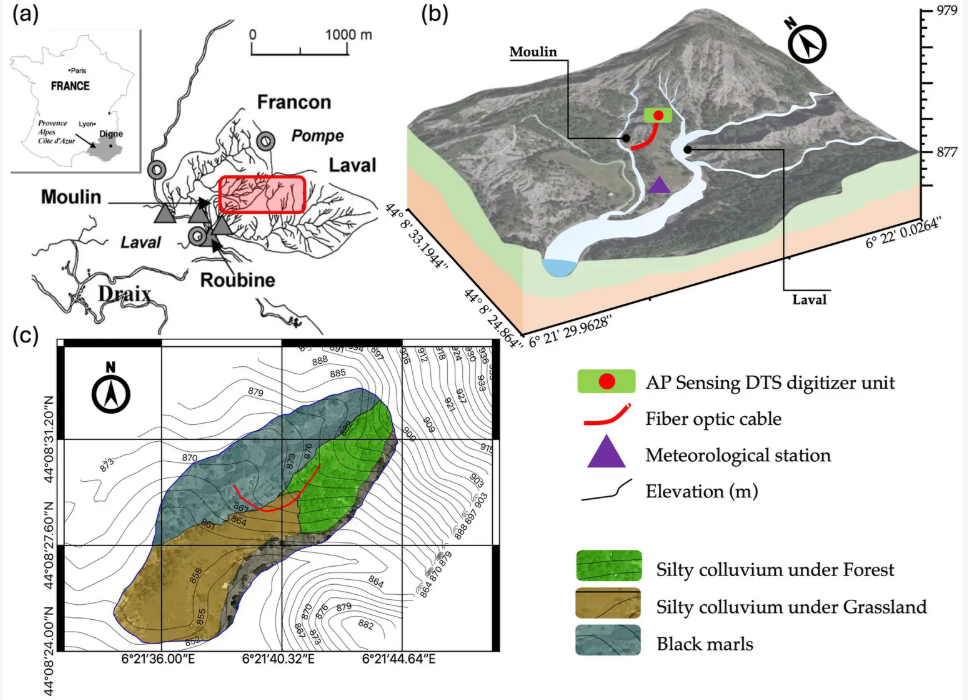
This paper presents a strategy to improve spatial and temporal volumetric water content (VWC) using passive DTS observation. We demonstrate this method using 22 months of passive fiber optic distributed temperature (FO-DTS). This method has previously encountered challenges, primarily due to noise effects and instability of diurnal temperature. We improve the water traceability by employing numerical estimation of the soil thermal diffusivity. This method was tested on a slope catena at the Draix–Bléone Mediterranean catchment (South-East France) and with synthetic data prior to applying it to field-scale scenarios. The results show a good performance as indicated by a determination coefficient of 0.92, a root mean square error of 0.06 m3/m3 and a mean relative percentage error of 1.41%. We conclude that the proposed strategy is convenient for analyzing passive DTS experiments using diurnal heat sources, where reliable thermal diffusivity and VWC data can be obtained without the use of active application sources.